
Summary
|
Your AI system is only as reliable as the knowledge it reasons from. The problem most enterprises hit is not that their LLM is underpowered: their retrieval layer is too shallow. Vector search returns semantically similar text; it cannot follow a chain of relationships, enforce access controls, or explain why a result was returned. When the stakes are high (fraud detection, regulatory compliance, clinical decision support), that gap matters.
Knowledge graphs built on top of LLM extraction give enterprise AI a structured, verifiable source of truth to reason from. LLMs are now making it practical to build that knowledge layer at a fraction of the effort it once required, opening real opportunities for organizations ready to move beyond prototype-level thinking.
Most tutorials on this topic focus on small-scale developer demos: a Python notebook, a few hundred entities, and a simple extraction loop. What they skip is what an enterprise build actually requires: data quality controls, schema governance, scalability, and the integration architecture that makes the graph useful in production.
In this guide you will learn:
- What role the LLM and the knowledge graph each play in a production pipeline
- How to design a schema that holds up at enterprise scale
- What the five-stage reference architecture looks like end-to-end
- The best practices that separate a production-grade knowledge graph from a proof of concept
- How the finished graph powers enterprise AI through GraphRAG
What Is a Knowledge Graph?
A knowledge graph is a structured database that stores entities – people, organizations, products, events, concepts – and the relationships between them. Unlike a relational database, which records facts about individual entities in separate tables, a knowledge graph makes the connections between entities a first-class data element, enabling multi-step relationship queries across millions or billions of records.
The practical implication for enterprise AI is that a knowledge graph can answer questions that require context: not just “what is similar to X?” (the job of a vector database) but “how does X relate to Y, and what does that relationship tell us?” That is the capability that makes knowledge graphs essential infrastructure for entity resolution, fraud detection, regulatory explainability, and any other use case where the connection between facts is as important as the facts themselves.
What LLMs Actually Do in a Knowledge Graph Pipeline
It is easy to assume that an LLM and the knowledge graph are the same thing. They are not. Each plays a different role, and understanding what each does well is the key to building an AI system that meets your organization’s reliability requirements.
The LLM is the extraction and transformation layer. It reads unstructured text, including documents, reports, web content, and transcripts, and identifies entities, relationships, and attributes that can be structured into a graph. It performs three core tasks:
- Named entity recognition: Identifying people, organizations, products, locations, concepts, and other domain-relevant entities within the source text.
- Relationship extraction: Identifying how those entities are connected, such as “company A acquired company B” or “drug X treats condition Y.”
- Entity disambiguation: Resolving whether two differently named entities refer to the same real-world object. At enterprise scale, this step is critical for accuracy. Without it, the same customer, product, or concept can appear dozens of times under slightly different names.
What the LLM does not do is equally important. It extracts seemingly correct information based on statistical patterns, but it does not validate those extractions against existing data, enforce schema consistency, or reason over the graph. That is the graph database’s job.
The core design principle is this: the LLM populates the graph and makes it accessible through natural language queries, while the graph database handles storage, validation, and reasoning. Keeping these roles clearly separated ensures the system stays dependable and scalable as it grows, and it ensures that LLM hallucinations are caught before they enter the graph, not after they have already propagated through it.
Design the Graph Schema Before You Build
Schema design is the step some developer-focused tutorials skip entirely. Instead, they jump straight to code. That shortcut is manageable at demo scale. At enterprise scale, it is the most common reason knowledge graph projects fail to reach production.
A schema defined after ingestion is difficult to enforce retroactively. It creates inconsistency at merge time and typically has to be rebuilt as new use cases emerge. A healthcare organization that ingests clinical notes without first defining entity types like Patient, Diagnosis, Treatment, and Physician will find, on first query, that the same diagnosis appears under dozens of slightly different names and the same patient is represented by multiple disconnected records. Fixing that requires full re-extraction, re-ingestion, and re-deduplication: a remediation effort that can take months at enterprise data volumes.
A well-designed knowledge graph schema defines four things before a single record is ingested:
- Entity types: The categories of entities the graph will contain: Person, Organization, Product, Event, Policy.
- Relationship types: The categories of connections between those entities, including directionality and cardinality.
- Properties: The attributes each entity or relationship carries, and which are required versus optional.
- Domain ontology: The controlled vocabulary and hierarchy of concepts that govern how entities are classified and disambiguated throughout the graph.
Schema design also requires close collaboration between domain experts, data architects, and AI engineers, since the LLM cannot always determine which distinctions are most important within a specific domain. A financial services graph needs to distinguish between a beneficial owner and a nominee director in ways that general-purpose extraction will miss without explicit guidance.
The property graph model is the preferred choice for enterprise AI workloads. It excels at representing connections among data scattered across diverse data architectures and schemas, making it well-suited to the heterogeneous source environments most enterprise builds start from. The multi-hop query performance of property graphs can also be important for AI requiring fast responses.
The Enterprise AI Knowledge Graph Pipeline: Five Stages
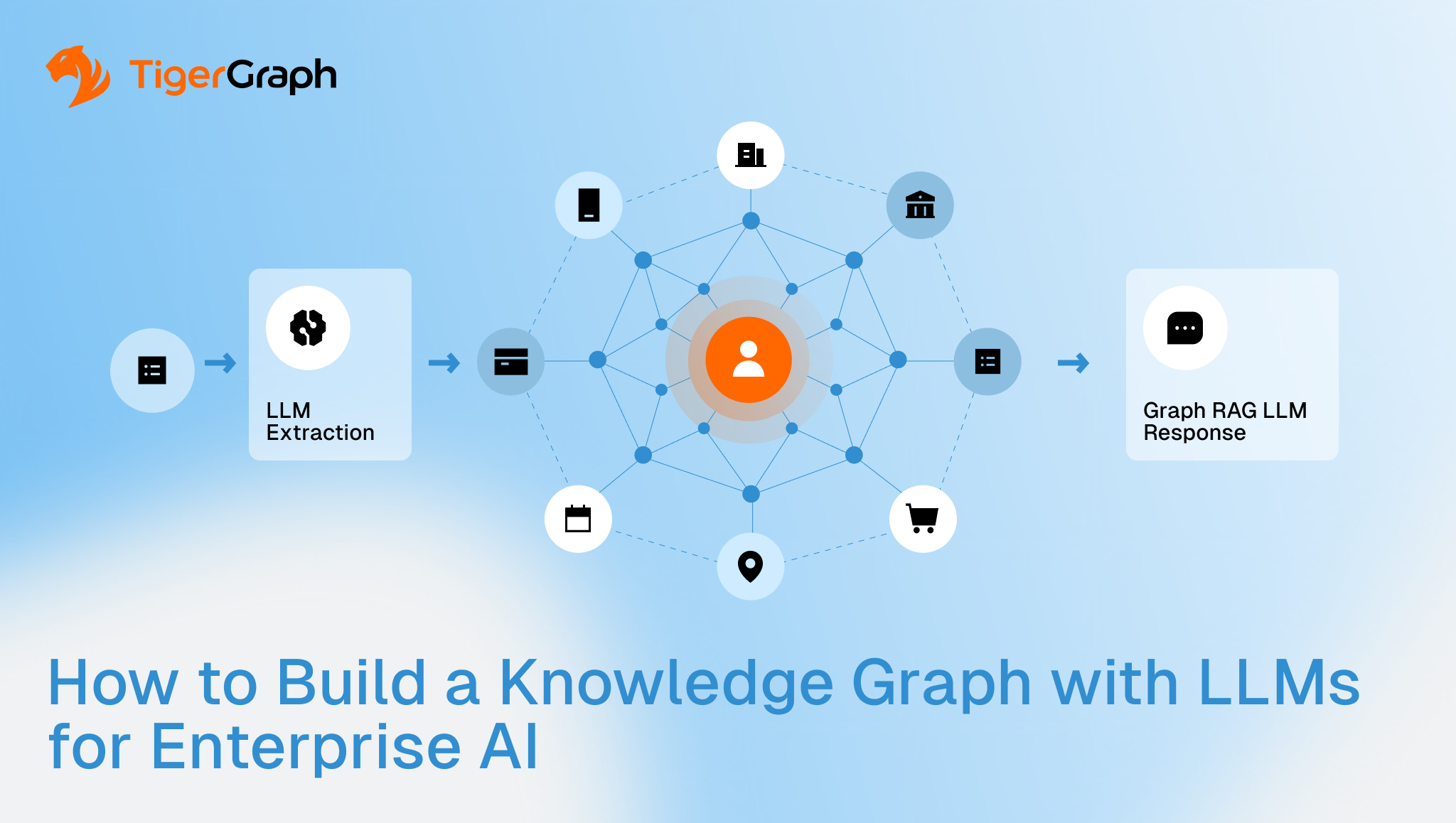
A production enterprise AI knowledge graph pipeline has five distinct stages, each with its own quality and governance requirements. Every stage must be implemented correctly for the graph to be accurate, scalable, and useful for AI inference. Skipping any one of them is the most common reason enterprise knowledge graph projects fail to reach production.
Stage 1: Data ingestion and preprocessing. Raw unstructured sources , including documents, emails, transcripts, and APIs, are cleaned, chunked, and formatted for LLM processing. Data quality problems introduced at this stage compound through every subsequent step. An ingestion pipeline that passes malformed or duplicate source records to the LLM will produce malformed or duplicate entities in the graph, and those errors become progressively harder to correct as the graph grows.
Stage 2: LLM-based extraction. The LLM performs named entity recognition, relationship extraction, and entity disambiguation against the predefined schema. A validation layer between the LLM and the graph is essential: schema-aware verification is the only reliable way to prevent hallucinated extractions from entering and propagating through the graph. A financial services team that skips this step may find fabricated regulatory relationships in their compliance graph months after ingestion, at a point where the affected records are too numerous to correct manually.
Stage 3: Entity resolution and deduplication. Extracted entities are matched against existing graph records to determine whether they are new or references to known ones. This step prevents duplicate entities from corrupting path analysis and silently degrading AI outputs. Entity resolution is not optional at scale: it determines whether the graph reflects reality or accumulates compounding noise over time.
Stage 4: Graph ingestion and schema validation. Validated records are loaded into the graph database against the predefined schema. The graph engine enforces structural consistency, updates relationships in real time, and rejects malformed data. Without schema enforcement at this stage, data ingested outside the defined model accumulates as unresolvable exceptions that require lengthy manual remediation.
Stage 5: Retrieval and query layer (GraphRAG). GraphRAG uses the populated knowledge graph as its retrieval layer, so LLM responses are grounded in real, structured relationships, something vector retrieval cannot provide. Every response traces to a verified path through the graph, making enterprise AI systems built on this layer accurate, explainable, and auditable by design.
When to Build a Knowledge Graph with LLMs
A knowledge graph with LLM extraction is the right architecture when one or more of the following conditions apply to your organization:
- Your AI needs to answer questions about relationships, not just content. If your use case requires knowing how entities connect, not just what they are, vector retrieval cannot provide that. Knowledge graphs can.
- Your data is unstructured and your entity volume is too large for manual curation. LLM-based extraction makes it practical to build a production-grade knowledge graph from documents, transcripts, and reports at scale.
- Explainability is a regulatory or operational requirement. Healthcare, financial services, and government use cases where AI outputs must be auditable require a retrieval layer that can show the reasoning path. GraphRAG over a knowledge graph provides that; vector RAG does not.
- You are experiencing entity fragmentation across systems. If the same customer, counterparty, or asset appears differently across multiple data sources, a knowledge graph with entity resolution closes that gap in a way that relational or vector architectures cannot.
- You are building for production, not experimentation. Knowledge graphs built with LLM extraction at enterprise scale require schema governance, validation layers, and a graph database with the performance to support real-time queries across billions of relationships. If those requirements match your use case, the architecture described in this article is the path forward.
Best Practices for Building Enterprise AI Knowledge Graphs with LLMs
The difference between a knowledge graph that powers production AI and one that stalls in proof-of-concept comes down to decisions made early in the build.
Define the ontology before running the LLM. Prompting an LLM against an undefined schema produces inconsistent entity types that are expensive to normalize. A biotech team that skipped this step ended up with seventeen variations of “Phase III trial” as distinct entity types, none compatible with the others for cross-trial queries. Ontology first, extraction second.
Validate LLM output before ingestion. Implement a validation layer that checks extracted records against the schema and flags low-confidence extractions for human review. This is cheaper than remediating fabricated or malformed records after they have propagated through a production graph.
Prioritize entity resolution as a first-class step. Failure to deduplicate entities is the most common cause of silent data quality degradation at scale. Address it with graph-native algorithms; a fraud detection system with duplicate customer records will miss ring structures that span those duplicates entirely.
Design for continuous ingestion, not a one-time load. Updating a knowledge graph changes only the relevant records and connections. Build the ingestion pipeline for real-time updates from day one, not as a retrofit.
Keep the graph and the LLM in separate layers. The LLM extracts. The graph stores and reasons. Mixing these responsibilities creates architectures where hallucinations propagate into the graph and compound over time.
Build for GraphRAG from the start. The entity types and relationship paths you define at schema design time become the paths GraphRAG will follow at inference time. Designing them with retrieval in mind produces a graph that is useful for AI inference from the first query.
Build the Knowledge Graph Your Enterprise AI Actually Needs
Most enterprise AI projects do not fail in the model layer. They fail in the knowledge layer: unvalidated extractions that corrupt the graph, duplicate entities that degrade query results, retrieval architectures that cannot explain what they return. The five-stage pipeline in this article exists to prevent exactly those failures and the graph database at its center is what determines whether the architecture holds at production scale.
TigerGraph is built for that requirement. Its massively parallel, native graph and vector architecture handles the entity resolution, schema validation, and GraphRAG retrieval that enterprise AI demands at scale, without stitching together separate systems for each stage.
FAQs
What is a knowledge graph LLM?
A knowledge graph LLM is an AI architecture that combines a structured knowledge graph with a large language model. The graph supplies verified entities and relationships; the LLM makes them accessible through natural language queries. The result is an AI system that produces factually grounded responses because it is reasoning from real, validated data rather than statistical patterns alone.
Can LLMs build knowledge graphs automatically?
LLMs can automate the extraction phase (named entity recognition, relationship extraction, and entity disambiguation from unstructured text), but a production-ready knowledge graph also requires schema design, validation, entity resolution, and governance that cannot be fully automated. Human judgment is required at ontology design and post-ingestion validation, particularly in domains where category distinctions have significant downstream consequences.
What is an LLM graph transformer?
An LLM graph transformer converts unstructured text into structured records, each in the form of (entity1, relationship, entity2) ready for ingestion into a graph database. It is the component that bridges raw content and a queryable knowledge graph, and it is where schema-aware prompting and validation make the difference between accurate extraction and a graph full of inconsistent records.
What is the difference between RAG and GraphRAG for knowledge graphs?
RAG retrieves documents based on semantic similarity between the query and stored text chunks. GraphRAG follows relationship paths through a knowledge graph to retrieve structurally connected, factually verified information. GraphRAG produces more accurate and explainable responses because it is grounded in verified entity relationships rather than text similarity patterns, and every result can be traced back to a specific path in the graph.