
Summary
|
Credit invisibility is not a reflection of financial behavior. For millions of Americans whose financial lives run through mobile wallets, gig income, and e-commerce platforms rather than traditional credit products, it is a gap in the data infrastructure lenders rely on. Bureau-only credit scoring was built for a different borrower profile, and it shows: a significant share of the US adult population either has no credit file or a file too thin or stale to score reliably.
Graph-powered credit risk analytics closes that gap by connecting alternative data sources and surfacing the relationship signals that bureau-only models cannot see.
Traditional credit scoring works well for borrowers with mature credit histories. But when your lending portfolio includes thin-file consumers, gig economy workers, small businesses, or applicants whose financial lives run through mobile wallets and e-commerce platforms, a bureau-only model will miss a significant share of creditworthy borrowers and misread risk for others.
Graph analytics changes both the inputs and the model. Rather than evaluating each borrower as an isolated record, it connects borrowers to every known data signal: transactions, devices, accounts, employers, guarantors, household relationships, and real-time behavioral patterns. Risk is assessed by analyzing those connections, not reading a flat file.
You will learn:
- Why traditional credit scoring fails thin-file and credit-invisible populations
- How graph-powered credit risk analytics differs from traditional risk models
- The role of relationship intelligence and alternative data in modern credit scoring
- How IceKredit operationalizes graph-based credit scoring at scale
- Where graph credit risk analytics applies across enterprise lending and risk management
Why Traditional Credit Risk Analytics Fails the Unscoreable
For decades, credit scores have been the standard tool lenders use to assess borrower risk. But credit scores are only as good as the data behind them, and that data only exists for borrowers who have already used formal credit products.
That creates a circular trap. A consumer with no credit history cannot get a credit score; without a credit score, they struggle to access credit products; without credit products, they cannot build the history a score requires. The system excludes the population it was never designed to serve.
Bureau-only credit scoring models have four specific limitations:
Thin or absent history. No file means no score, regardless of actual financial behavior or stability. A borrower who has paid rent on time for a decade but never held a credit card is invisible to this model.
Static or stale data. Credit bureau files can lag behind a borrower’s current financial reality. Recent income changes, new debt, or improved repayment behavior outside traditional credit products may not appear in the bureau record for months.
No relationship context. Bureau scoring treats each borrower as an isolated profile. It cannot model the financial network around that borrower: employers, guarantors, household relationships, or business connections, all of which carry meaningful risk signals. A borrower whose primary guarantor has three prior defaults is a different risk than one who does not, but a flat bureau model cannot see that connection.
Fragmented modern data. Traditional credit infrastructure was built for structured, predictable data. It struggles to efficiently connect and analyze the volume and variety of modern signals: e-commerce activity, mobile payments, gig income, utility history, and behavioral patterns from digital platforms.
This is not only a financial inclusion problem but also a risk management one. Excluding thin-file consumers caps your addressable market and hands potentially creditworthy borrowers to competitors or informal lenders. To move beyond that limitation, you need a model that connects fragmented financial signals and understands the relationships around each borrower. That is where graph-powered credit risk analytics changes the equation.
What Is a Graph Database?
A graph database creates a persistent, queryable map of how entities relate to one another. In a credit risk context, that means connecting each borrower not just to their own financial record, but to every other entity that shares a meaningful connection with them: a co-applicant who shares a device, a guarantor who shares a business address with a previously defaulted borrower, a small business whose ownership structure links to entities with prior AML flags.
These connections are invisible in a flat credit model. They become visible the moment the data is connected in a graph.
What Graph-Powered Credit Risk Analytics Does Differently
Graph-powered credit risk analytics does not start from a different bureau file. It starts from a different question. Traditional scoring asks: “What does this borrower’s record show?” Graph analytics asks: “What does this borrower’s network reveal?”
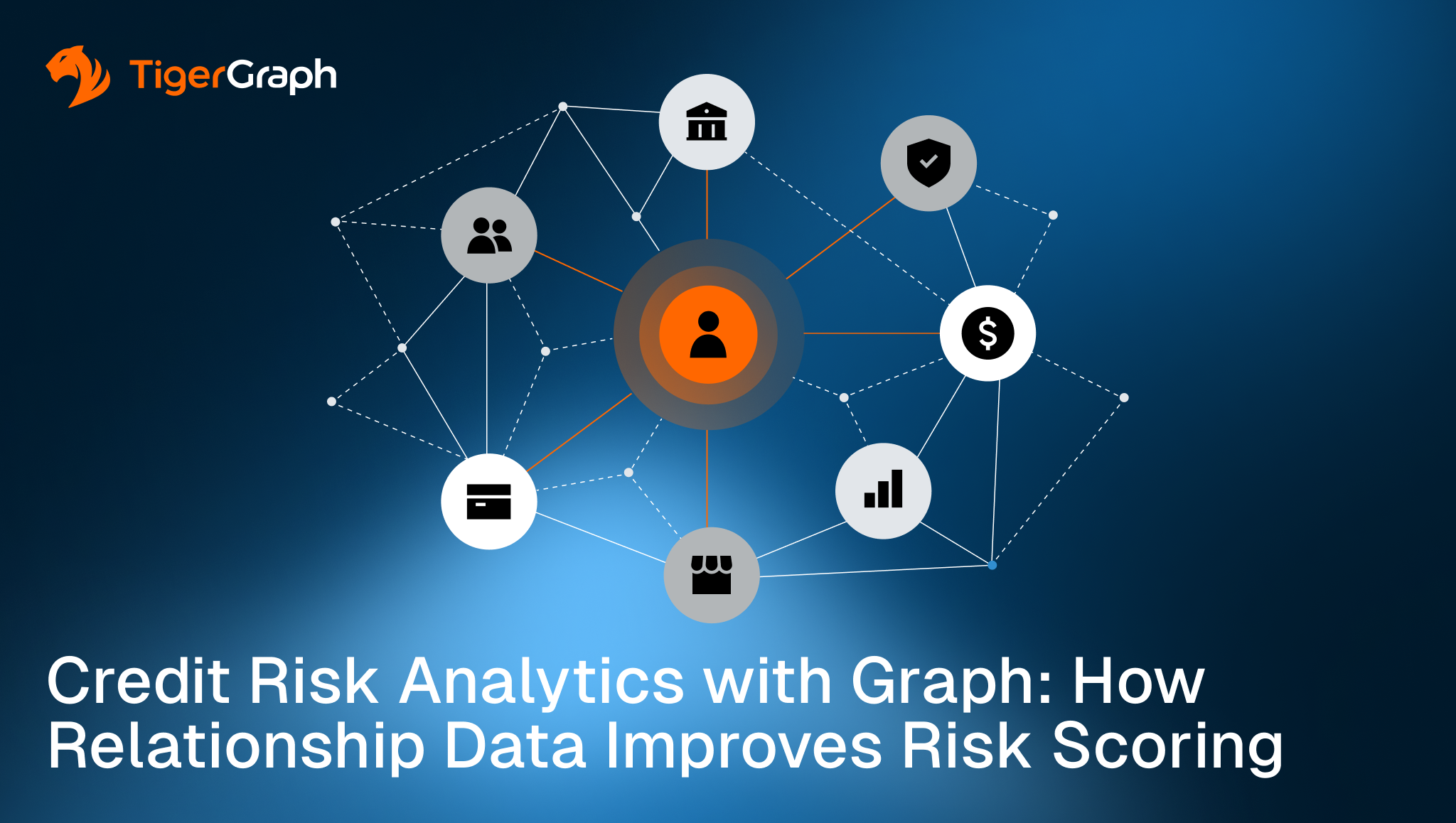
In a graph credit risk model, the borrower is connected to every known signal: transactions, devices, accounts, employers, guarantors, social connections, geographic patterns, and real-time behavioral data. Risk is assessed by analyzing those connections.
Graph adds five capabilities to credit risk analytics that bureau scoring cannot provide:
Alternative data integration. A graph database can ingest and connect disparate data sources: mobile wallet transactions, e-commerce activity, microloan repayment records, utility payments, and rental history. New data sources can be added to the risk model without restructuring the entire pipeline.
Relationship-based risk signals. Graph analytics surfaces signals that do not exist in any individual record. A borrower whose employer, guarantor, and primary reference all share the same device identifier. A business applicant whose ownership structure connects to entities with prior defaults. These patterns are only visible when the data is connected.
Network risk propagation. Credit risk does not exist in isolation. When one borrower in a guarantor network defaults, the risk to other connected borrowers can increase. A graph model carries those risk signals across connected relationships in real time and updates scores accordingly.
Real-time scoring. A graph database evaluates connected relationships quickly enough to support credit decisions at the point of application, not hours after batch processing. New data inputs can be added without changing the core model, so risk scores update as new signals arrive.
Explainability. Graph analytics can show not only that a borrower’s risk profile changed, but how that change connects to specific relationships, behaviors, or network patterns. That explainability matters for regulatory compliance: CFPB guidance on adverse action notices requires lenders using AI or complex models to provide specific and accurate reasons for adverse actions, not broad or vague explanations.
Together, these capabilities shift credit risk analytics from static borrower evaluation to real-time relationship intelligence.
Graph vs. Traditional Credit Scoring: Key Differences
Graph-based credit risk analytics does not replace bureau scoring where reliable bureau data exists. It extends and enriches traditional credit models and fills the gap when bureau data is thin, stale, or unavailable.
| Metric | Traditional Credit Scoring | Graph-Powered Credit Risk Analytics |
| Primary data inputs | Credit bureau records: repayment history, account age, credit utilization, inquiry patterns | Bureau data plus alternative data: mobile wallet activity, e-commerce transactions, utility payments, rental history, device signals, guarantor relationships, business connections |
| Coverage of thin-file populations | Limited: borrowers with no formal credit history often remain unscored | Stronger: alternative data and relationship signals can build a risk profile even when bureau history is limited |
| Relationship and network signals | Minimal: borrowers evaluated as isolated profiles | Strong: borrowers evaluated in the context of connected accounts, devices, employers, guarantors, households, businesses, and prior defaults |
| Score update frequency | Often batch-based and backward-looking | Real-time or near real-time as new transactions, behaviors, and relationship changes enter the model |
| Explainability | Attribute-based explanations tied to bureau factors | Relationship-based explanations showing which connected entities, behaviors, or exposure patterns influenced the risk score |
| Integration of alternative data | Difficult: new sources often require schema changes, data normalization, or model redevelopment | More flexible: new data sources connect into the risk model without rebuilding the underlying architecture |
| Best-fit applications | Established borrowers with mature credit files and stable repayment histories | Thin-file lending, fraud-aware underwriting, portfolio risk monitoring, counterparty risk, BNPL, embedded finance |
For enterprise risk leaders, the most important differences are real-time scoring and explainability. Real-time scoring matters because credit risk changes: borrower behavior shifts, connected entities default, portfolio exposure concentrates. Explainability matters because lenders must justify decisions – especially when using complex models or alternative data.
Graph-based credit risk analytics has a practical advantage on both dimensions: it updates scores as new signals arrive, and it can attribute risk changes to specific relationships and behaviors in the network.
IceKredit: Scoring the Unscoreable at Scale
IceKredit offers a direct example of how graph-powered credit risk analytics moves from concept to production. The fintech set out to build credit scores for individuals and small businesses with limited or no traditional bureau history across the United States, China, and Southeast Asia: borrowers who generate meaningful financial signals through digital activity, payments, and business relationships, but whose profiles remain incomplete or invisible to conventional scoring models.
To solve this, IceKredit built a Customer 360 Graph on TigerGraph. The model connected traditional bureau data where available with alternative data sources: e-commerce transactions, mobile wallet records, microloan repayment history, and government, public, and private data. The value of the graph was not simply that it stored more data; it connected signals that no single source could reveal on its own.
Within IceKredit’s credit analytics pipeline, graph analytics helped identify undisclosed relationships between applicants, guarantors, businesses, and other connected entities – the kind of hidden connections that inflate or mask risk when evaluated in a flat model. Risk ratings could be assigned and updated in real time as new data arrived, rather than waiting for periodic batch recalculation. IceKredit’s anti-fraud engines used the same connected view to quantify fraud probability alongside creditworthiness, allowing fraud risk and credit risk to inform the same decisioning process.
The commercial outcome was a broader addressable credit market without abandoning risk discipline. By scoring borrowers that bureau-only models could not evaluate, IceKredit demonstrated how graph analytics can simultaneously support financial inclusion and strengthen risk management.
Where Graph Credit Risk Analytics Applies Across the Enterprise
Consumer and Small Business Lending for Thin-File Populations
If your current credit model cannot evaluate applicants without a bureau file, you are missing a segment of the market that may be creditworthy but data-invisible. Graph credit risk analytics helps you build richer profiles by connecting alternative data: mobile payments, e-commerce activity, utility records, rental history, and microloan repayment behavior. Applicants who would otherwise be declined or left unscored become evaluable.
Portfolio Risk Monitoring and Early Warning
Graph analytics supports real-time portfolio monitoring by propagating risk signals across guarantor networks, corporate ownership chains, household relationships, and shared-collateral clusters. When one borrower’s risk profile deteriorates, you can immediately assess the impact on connected borrowers in the same network and intervene before defaults cascade. This is central to effective risk assessment and monitoring: continuous visibility into connected exposure, not just periodic batch reporting.
Corporate and Counterparty Credit Risk
A flat balance-sheet analysis misses concentration risk that sits several relationships away from the direct borrower. Graph models complex business relationships, beneficial ownership structures, supplier dependencies, and inter-entity exposure to surface that risk before it becomes a problem. This is especially valuable in commercial lending, trade finance, and counterparty risk management.
Regulatory Compliance and Sanctions Screening
A borrower may have no direct sanctions exposure but share directors, beneficial owners, or business relationships with higher-risk entities. Graph connects borrower identities with sanctions lists, politically exposed person databases, adverse media, and counterparty networks to surface those indirect connections. This same relationship-aware approach is central to AML and KYC workflows, where graph databases help institutions uncover hidden financial crime patterns that rule-based systems miss.
Buy-Now-Pay-Later and Embedded Finance
Graph-powered risk analytics helps BNPL and embedded finance providers make real-time underwriting decisions at the point of sale by combining transaction history, device signals, behavioral patterns, and connected risk indicators. When applicants, devices, merchants, and payment patterns are related in ways that rule-based systems cannot see, graph analytics surfaces the risk before the decision is made. The same connected-risk approach also strengthens fraud detection across these channels.
Why Enterprise Graph Credit Risk Analytics Needs a Production-Grade Platform
Building graph credit risk models in a proof-of-concept environment is straightforward. Operationalizing them at enterprise scale, with real-time response times, ACID-compliant transactions, and a data model that can absorb new alternative data sources without rebuilding the pipeline, is where most graph projects stall.
The gap between pilot and production is the most common failure point in enterprise graph analytics. At small scale, most graph databases perform adequately. Under production conditions: hundreds of millions of relationship records, real-time scoring requirements at point-of-application, and fraud detection running across the same connected dataset simultaneously, performance degrades sharply in architectures not built for it.
For financial institutions evaluating whether to build or expand graph credit risk analytics capabilities, the question is not whether graph analytics can improve your decisioning. IceKredit and others have already answered that. The question is whether your graph infrastructure can support production requirements: real-time scoring, enterprise-scale relationship processing, and explainability that satisfies regulators.
Explore TigerGraph’s risk assessment and monitoring solution or request a demo to see graph credit risk analytics in action.
FAQs
What is credit risk analytics?
Credit risk analytics uses data, statistical models, and analytical tools to assess the likelihood that a borrower will default on a financial obligation. Traditional credit risk analytics relies primarily on credit bureau data: payment history, account age, credit utilization, and inquiry patterns. Graph-powered credit risk analytics extends that model by incorporating alternative data and relationship signals across the network of entities connected to each borrower.
How does a graph database improve credit risk scoring?
A graph database surfaces risk signals that exist in a borrower’s relationship network but are invisible to flat credit models. These include shared devices across an applicant and their guarantors, ownership structures that link a business applicant to entities with prior defaults, and guarantor networks where one borrower’s deterioration increases risk for connected borrowers. These signals are only visible when the data is connected rather than evaluated record by record.
What is the best approach to scoring thin-file or unbanked borrowers?
Graph-based credit analytics is the most effective approach for thin-file borrowers because it connects alternative data sources into a unified borrower model, enabling credit assessment without depending on bureau history alone. Alternative data can include mobile wallet transactions, rental payment history, utility payments, e-commerce activity, microloan repayment records, and behavioral signals from digital platforms. These sources are connected and analyzed in the graph model alongside whatever bureau data exists.
Does TigerGraph support graph-based credit risk analytics?
Yes. TigerGraph’s enterprise graph platform is purpose-built for the kind of production-scale, real-time workloads that credit risk analytics requires. IceKredit built its credit scoring system for thin-file borrowers across the US, China, and Southeast Asia on TigerGraph, selecting it over Neo4j for its processing capacity and performance on complex real-time analysis. TigerGraph’s risk assessment and monitoring solution is designed for financial institutions that need continuous, relationship-aware visibility into credit and portfolio risk.
How does graph analytics help with credit portfolio risk management?
Graph analytics propagates risk signals across connected borrower networks in real time. When one borrower in a guarantor chain or shared-collateral cluster deteriorates, the system immediately assesses the exposure across every connected borrower, enabling lenders to act before defaults spread. This is a significant improvement over batch-based portfolio monitoring, which may not surface connected risk until it has already cascaded